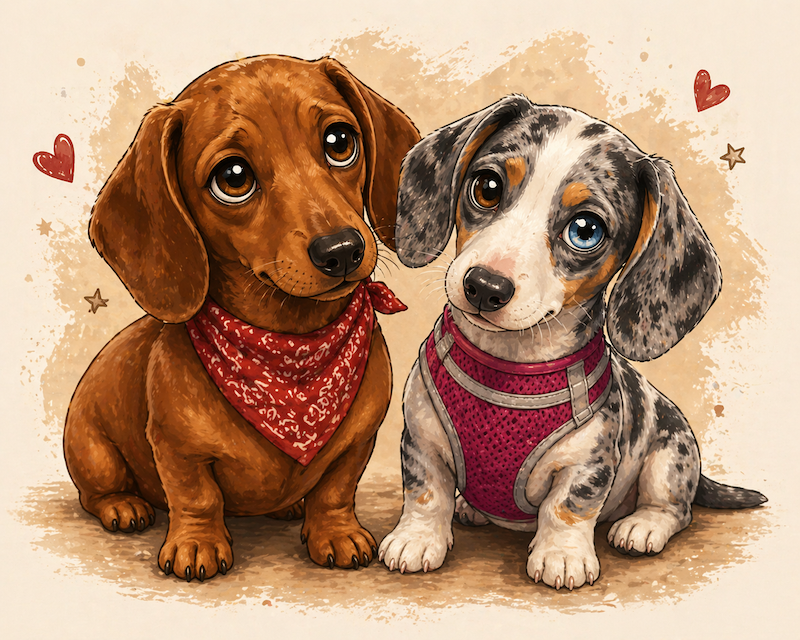
When I first looked into Esmae’s eyes, I noticed something unusual — a starburst pattern in her pupil, as though her iris had fractured into a kaleidoscope. She’s a dachshund, and she’s double dapple. That starburst is one of the hallmarks of the condition. We believe she can see, but we genuinely don’t know how much, and we likely never will. What we do know is that she should never have been bred that way.
This post is for every dog owner, breeder, or rescue worker who has ever seen a dapple dachshund or a merle dog and thought they were simply beautiful markings. They can be. But behind those markings lies a gene that, when doubled up, can cause profound and irreversible harm. Here’s what you need to know.
What Is the Merle Gene?
Merle is a coat pattern caused by a mutation in the PMEL17 gene (also called SILV). It creates a patchy, diluted pattern by randomly switching off pigment in certain areas of the coat and skin. In dachshunds, this pattern is called dapple. The gene itself is the same — only the breed name differs. Collies, Australian Shepherds, Great Danes, and Chihuahuas all carry merle; dachshund breeders simply call it by a different name.
A dog with one copy of the merle gene (Mm) is a single merle or single dapple. They will have the characteristic patchy coat and may have blue or partially blue eyes. As a single-copy carrier, the health risks are generally manageable, though some degree of hearing or vision impairment is still possible.
A dog with two copies of the merle gene (MM) is a double merle, or in dachshund terms, a double dapple. This is where the serious welfare concerns begin.
Starburst Pupils: What They Are and Why They Happen
One of the most striking signs of double merle is an irregularly shaped pupil — sometimes called a starburst pupil or coloboma. Rather than the normal round or oval shape, the pupil appears jagged, star-shaped, or keyhole-like. It can look almost beautiful, in a strange way — which is part of why it’s so important to understand what it actually means.
A coloboma occurs when the iris, retina, choroid, or optic nerve fails to close completely during foetal development. In double merle dogs, the depigmentation caused by the doubled gene disrupts normal eye development. The eye structures that rely on melanocytes — pigment cells — to develop correctly simply don’t form properly.
Esmae has a starburst pupil in one eye. We believe she has some vision, but we cannot be certain of its extent. Dogs like Esmae may experience:
- Partial or complete blindness in one or both eyes
- Sensitivity to bright light (photophobia)
- Abnormal retinal development or retinal detachment
- Micropthalmia (abnormally small eyes) or anopthalmia (absent eyes)
The Full Health Picture: What Double Dapple Can Cause
Vision problems are only part of the story. The merle gene acts on pigment throughout the body, and melanocytes are not just responsible for colour — they are essential to the development of the inner ear and other structures. When two merle genes combine, the damage can be widespread.
Hearing & Deafness
This is arguably the most common and most serious consequence. The cells lining the cochlea (the hearing organ in the inner ear) depend on melanocytes to function. Without pigment, these cells die, and the result is sensorineural deafness — permanent and untreatable. Deafness may be:
- Unilateral (one ear) — often undetected without specialist BAER testing
- Bilateral (both ears) — the dog may appear unresponsive and is often mistakenly labelled as “stubborn” or “difficult”
Studies suggest that up to one in three double merle dogs will be deaf in at least one ear. Many rescue dogs with unexplained behavioural challenges turn out to have undetected hearing loss.
Vision Problems
Beyond starburst pupils and colobomas, double merle dogs are at elevated risk for:
- Microphthalmia — one or both eyes abnormally small, sometimes sunken or non-functional
- Anophthalmia — complete absence of one or both eyes
- Cataracts and lens abnormalities
- Retinal dysplasia or detachment
- Nystagmus (involuntary eye movement)
Skin, Coat & Immune System
White patches in double merle dogs are not simply a cosmetic feature. Skin that lacks pigment has no UV protection in those areas, increasing the risk of sunburn and skin cancer over time. Some double merle dogs also show an increased susceptibility to immune dysfunction, though the research in this area is still developing.
Hidden Merle & Cryptic Merle: The Invisible Risk
This is where the genetics get genuinely complicated — and genuinely dangerous. Not every merle dog lookslike a merle.
Cryptic Merle (Also Called Phantom Merle)
A cryptic merle dog carries the merle gene but shows little or no visible merle patterning in their coat. They may appear to be a solid or standard-coloured dog. The merle allele in cryptic merle dogs tends to have a shorter SINE insertion (the DNA sequence responsible for the merle effect), meaning the gene’s effect on pigment is minimal — but the gene is still there, still heritable, and still capable of doubling up in offspring.
A breeder who pairs two apparently non-merle dogs, one of whom is a cryptic merle, can unknowingly produce double merle or double dapple puppies. This is not an excuse — it is a reason why DNA testing before any merle-related breeding is non-negotiable.
Dilute Merle
Dilute merle dogs carry both the merle gene and a dilution gene. Their coat colour is already pale (blue, silver, or cream), which can further mask the merle patterning. Again — the gene is present regardless of what the coat looks like.
Harlequin Merle
Seen primarily in Great Danes, harlequin is caused by an additional gene that interacts with merle, converting grey merle patches to white. Harlequin dogs are always merle at their base, and harlequin-to-harlequin breeding carries the same double merle risks.
Why Dapple-to-Dapple (or Merle-to-Merle) Breeding Is Never Acceptable
When two single merle (double dapple) dogs are bred together, the statistical outcome for each puppy is:
| Outcome | Genotype | Probability |
| Non-merle | mm | 25% |
| Single merle (healthy carrier) | Mm | 50% |
| Double merle — at high risk of serious health defects | MM | 25% |
That means every litter from two dapple or two merle parents has a one-in-four chance of producing a severely disabled puppy. There is no breeding technique or careful management that changes these odds. The only way to prevent double dapple puppies is not to breed two merle dogs together.
In the UK, dapple-to-dapple breeding is condemned by the Kennel Club and considered a significant welfare concern by the British Veterinary Association. Responsible breeders who work with dapple or merle lines always pair a single merle with a non-merle partner.
Why This Still Happens
Double dapple and double merle dogs continue to be bred for a number of reasons, none of them acceptable:
- Ignorance — some breeders simply do not know the genetics involved
- Profit — double merle dogs often have striking, unusual coats that attract buyers willing to pay premium prices
- Hidden merle — breeders may not know one or both parents carries the gene if DNA testing has not been done
- Unregulated breeding — puppy farms and backyard breeders frequently operate without any genetic awareness
Living With a Double Dapple Dog
If you have a double merle or double dapple dog — like Esmae — please know that they can live full, happy, rewarding lives. Many deaf or partially sighted dogs adapt remarkably well, especially when their owners take the time to understand their needs and communicate in ways that work for them.
Key things to be aware of with a double merle dog:
- Request a BAER (Brainstem Auditory Evoked Response) test to accurately assess hearing in each ear
- Have eyes assessed by a veterinary ophthalmologist
- Use vibration-based signals, hand signals, or a vibrating collar (never shock) if your dog is deaf
- Protect depigmented skin from prolonged sun exposure
- Approach gently and predictably — a deaf or partially blind dog can be startled and may react
- Connect with organisations and communities experienced in supporting deaf and visually impaired dogs
The Last Word from Maddie
Esmae didn’t ask to be born with a starburst pupil. She didn’t choose the breeding decision that brought her into the world the way she is. But here she is, double dapple — funny, stubborn, and deeply loved. She deserves every bit of it. What she doesn’t deserve is to be one of thousands born this way every year because someone wanted a pretty coat and didn’t ask the right questions, or didn’t care about the answers.
Share this. Ask the questions. Push for the tests. And if someone tells you a double dapple puppy is just a bit different-looking — walk away. Some of us know better than most what it means when humans don’t. I’m a puppy farm dog myself — but that’s a story for another day. ★