Access refusals are not a new problem in the assistance dog community. Handlers have been fighting for their legal rights in shops, restaurants, taxis, and public spaces for years. But when a major national pub chain quietly updates its policy to restrict access to only certain assistance dogs, it stops being an individual incident and becomes something worth talking about loudly.
This post is about that policy, why it is unlawful, and what you can do if you or someone you know is ever refused access with an assistance dog. But first, let’s lay the groundwork — because understanding the law is the most powerful tool any handler can carry.
What the Law Actually Says
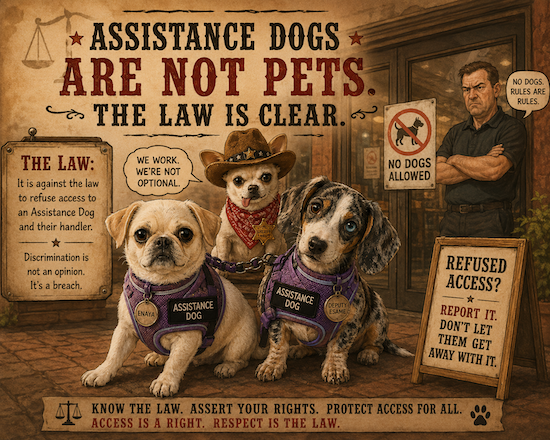
In the UK, assistance dog access rights are protected under the Equality Act 2010. The law is clear: a service provider — which includes pubs, restaurants, shops, hotels, and transport providers — must not refuse access to a disabled person who is accompanied by an assistance dog.
There is no requirement for the dog to be registered with any organisation. There is no requirement for the dog to wear a specific jacket or carry specific ID. There is no approved list of charities or trainers that a dog must have come from. What matters, under the law, is that the dog is trained to carry out real tasks that assist with the handler’s disability, and that it is well-behaved in public.
The Equality and Human Rights Commission has issued statutory guidance on this, which ADUK (Assistance Dogs UK) actively uses to educate service providers. The guidance is unambiguous. Refusing access on the grounds that a dog is owner-trained, or that it doesn’t come from an ADUK member organisation, is not a legal basis for refusal. It is discrimination.
The Scale of the Problem
In February 2026, ADUK published a statement that stopped many of us in our tracks. In the previous year, 79% of people partnered with an assistance dog in the UK had been denied access to a public place.
Let that number sit for a moment. Nearly eight in ten handlers. Not a minority experience, not an occasional incident — the overwhelming majority. This is a systemic failure, and it is happening in a country where the legal protection exists and is clear.
ADUK has called for clearer definitions in law, consistent training and welfare standards, and better education of service providers about their legal obligations. Those are reasonable asks. In the meantime, handlers are navigating a landscape where knowing your rights is not a nicety — it is a necessity.
The Wetherspoons Policy — And Why It Matters
Against that backdrop, news emerged that Wetherspoons — one of the UK’s largest pub chains — had updated its internal policy to permit access only to assistance dogs trained by ADUK member organisations.
On the surface, this might sound like a quality assurance measure. In practice, it is unlawful. As we’ve established, the Equality Act 2010 does not contain a provision allowing service providers to impose their own training standards as a condition of entry. A handler with a well-trained, task-performing assistance dog — whether that dog came from a charity, a programme, or was owner-trained — has the same legal right of access.
What Wetherspoons has done, whether intentionally or through poor legal advice, is publish a discriminatory policy and call it procedure. Any handler turned away under that policy has grounds to challenge the refusal. And any business that follows suit should be aware that they are exposing themselves to the same legal risk.
For what it’s worth, Mad’s Muse will not be recommending Wetherspoons. There are plenty of establishments that understand their obligations and welcome handlers and their dogs without question. We’ll be pointing you toward those instead.
What to Do If You’re Refused Access
Being refused access is stressful, often humiliating, and unfortunately common. Here is what I’d recommend in the moment and afterwards.
In the moment:
- Stay calm. You are in the right, and escalating rarely helps.
- Ask for the refusal in writing, or ask for the name of the person refusing you and the reason given.
- Note the date, time, location, and as many details as you can as soon as possible afterwards.
- If you carry access cards or handler information, offer them — but know that you are not legally required to prove anything.
Afterwards:
- Report the incident to ADUK via their website. They track refusals and use the data to advocate for legislative change.
- Contact the Equality Advisory and Support Service (EASS) for free advice on making a complaint or taking further action.
- Consider reporting to the business’s head office or complaints team in writing — a paper trail matters.
- Share your experience (where you feel safe to do so) — community awareness helps other handlers know where risks exist.
The Bigger Picture — Why the Law Needs to Change
Knowing your rights is essential. But it shouldn’t have to feel like carrying a shield every time you leave the house. The current law, while protective in principle, lacks the clarity and enforcement mechanisms that would make a real difference on the ground.
ADUK, alongside sector partners, has been calling for legislative change — clearer definitions of what constitutes an assistance dog in law, consistent standards that all working dogs can be measured against, and better accountability for service providers who refuse access unlawfully.
If this matters to you — and if you’re reading this, it probably does — there are things you can do. Follow ADUK’s campaigns at assistancedogs.org.uk. Write to your MP. Share accurate information when you see misinformation circulating. Support organisations doing the work.
Change is slow. But 79% is not a statistic we should be comfortable with, and the more noise we make about it, the harder it becomes to ignore.
Maddie’s Last Word
I have been going into places with my person for years. Shops, waiting rooms, the odd café that smelled better than it looked. In all that time, the number of people who have handled a refusal situation with more dignity than they deserved to have to is frankly remarkable.
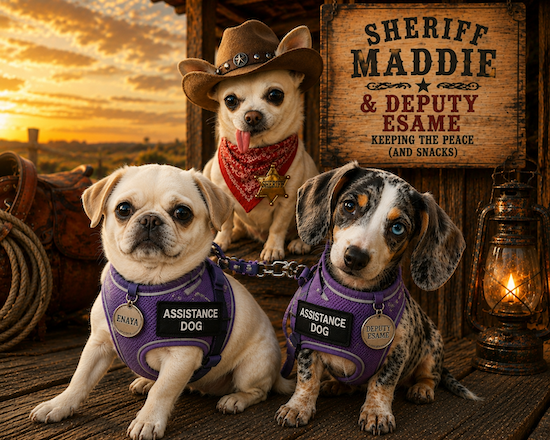
Enaya and Esmae are going to encounter this too. They will be questioned, stared at, occasionally told they shouldn’t be somewhere they absolutely have every right to be. That’s the reality of the world they’re working in.
What I will say is this: the dogs always know. When someone’s being difficult, when the room has gone tense, when my person’s shoulders have gone up slightly — they feel it. That’s not nothing. That’s exactly why the job matters.
As for Wetherspoons specifically — I’ve never been, and it sounds like I’m not missing much.