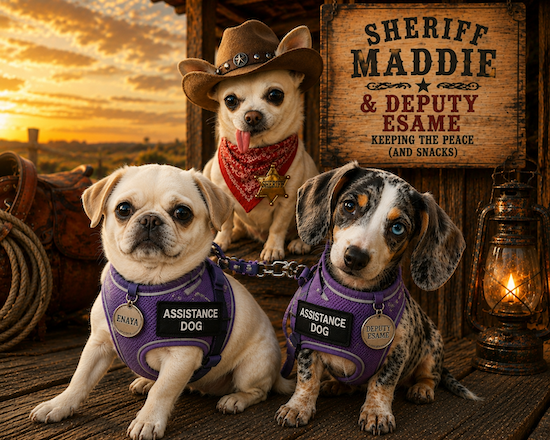
When people see me out with Enaya and Esmae, I get looks. Sometimes questions. Sometimes just a long, pointed stare at the two leads in my hand. I get it — one person, two assistance dogs isn’t something most people have come across. And in a world where the assistance dog community is already misunderstood, working a tandem team can feel like you’re asking for extra scrutiny.
But here’s the thing: the tandem team isn’t a workaround. It’s not two dogs because I couldn’t choose, or because I wanted the company. It’s the most logical, most practical solution to a genuinely complex set of medical needs — and it took me a while to stop apologising for that and start owning it.
This post is for anyone who’s curious, anyone who’s been in a similar situation, and anyone who’s ever felt like their needs were too complicated to fit neatly into the box.
My Conditions — And Why They’re Complicated
I live with EDS (Ehlers-Danlos Syndrome), HyperPOTS, and MCAS (Mast Cell Activation Syndrome). If you’re not familiar with any of those, the short version is this: my body is unpredictable. My support needs fluctuate significantly depending on the day, the environment, my stress levels, and factors I often can’t anticipate or control.
EDS affects my connective tissue, which means joints, stability, and pain are ongoing considerations. HyperPOTS affects my autonomic nervous system — heart rate, blood pressure, and how my body responds to positional changes. MCAS means my immune system can react to triggers that most people wouldn’t give a second thought to.
Together, they create a picture that shifts. A good day might look very different from a bad one, and my support needs shift accordingly. That’s where the tandem team comes in.
Meet the Team
Enaya — Retrieval & Response
Enaya is being trained in retrieval and response tasks, as well as alert training for changes in my heart rate and blood sugar. She is also being trained to alert and respond to changes in my body and environment. Where Enaya shines is in the practical, task-focused support — the things that keep me functioning safely when my body decides to do something unexpected.
Esmae — Grounding & Recovery
Esmae’s role is grounding, regulation support, and helping me recover from episodes, as well as alert training for changes in my heart rate and blood sugar.When my nervous system is dysregulated, or when I’m coming out of a difficult episode, Esmae is the one who helps me find my way back. Her presence is stabilising in a way that is hard to quantify but very easy to feel.
You might also recognise Esmae from the starburst pupil post — she is a double dapple dachshund with a distinctive eye that has become something of the blog’s calling card. She arrived carrying the consequences of irresponsible breeding, which is part of why that topic matters so much to me.
Why Both? Why Not Just One?
This is the question I get asked most, and it’s a fair one. The honest answer is that I tried to work out which dog to use, and I kept hitting the same wall: they have different strengths, and my needs are varied enough that one dog would always be covering a gap.
Working both means that between them, Enaya and Esmae can support different aspects of my daily life. On a day when I need practical task support, Enaya leads. On a day when I need grounding and regulation, Esmae leads. On many days, I need both — and that’s exactly what the tandem setup allows for.
There was also a practical reality: neither of them is particularly happy being left behind. Dogs that have been worked as part of a team, or that have been trained alongside a sibling, can find separation difficult. Taking them both is better for their welfare as well as mine.
Is a Tandem Team Legal in the UK?
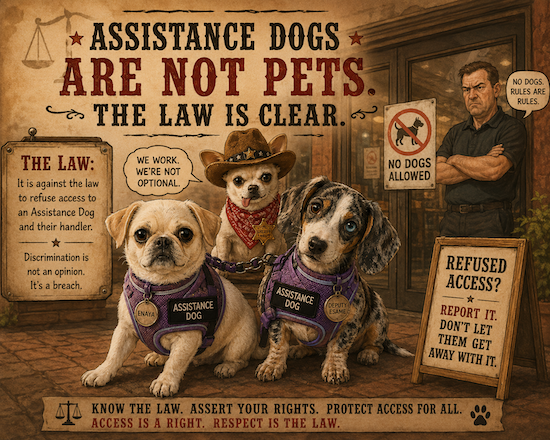
Yes. Under the Equality Act 2010, a disabled person has the right to be accompanied by their assistance dog in public places. The law does not cap the number of dogs, nor does it require them to be registered with any organisation. What matters is that the dogs are trained to carry out real tasks that assist with a disability, that they are well-behaved in public, and that the handler can manage them safely.
Enaya and Esmae both wear harnesses that clearly identify them as assistance dogs in a tandem team, with their individual roles displayed. We also carry cards that explain the setup, the conditions I live with, and the legal position — because preparation is better than confrontation.
That said, access refusals are still very common in the UK — even for single dog handlers. ADUK reported in February 2026 that 79% of assistance dog handlers had been denied access to a public place in the previous year. It is a serious problem, and one we will be addressing in a future post.
What the Tandem Setup Has Given Me
Confidence. That’s the simplest answer. Knowing I have the right support for whatever kind of day I’m having means I can go out more, do more, and worry less about what might happen if my body decides to be difficult.
It also gave me a framework to build around. The business cards, the harness patches, the identification — all of it tells a clear, consistent story before anyone has had to ask a question. That preparation has already changed how public access feels.
And honestly? Watching them work together — or watching them both curl up at the end of a long day — is one of the good things. They made the decision as much as I did.
Maddie’s Last Word
Right. I’ve been watching all of this unfold from my spot on the sofa, and I have thoughts.
Enaya is enthusiastic. I’ll give her that. She comes at everything like it’s the most exciting thing that has ever happened, which is either admirable or exhausting depending on how recently I’ve had a nap. She’s good at her job. I can acknowledge that without it being a whole thing.
Esmae is quieter. She arrived looking like she’d already seen too much of the world, which I understand more than most. She’s found her feet now. She has a tendency to steal the warmest spot and then look innocent about it, which is a skill I respect.
Together they cover a lot of ground. Watching them settle into their roles has been — and I will only say this once — quite something. Don’t tell them I said so.
The tandem team makes sense. Anyone who tells you one dog must cover everything has never lived with a body that won’t cooperate. You use what works. That’s not a compromise. That’s just sense.