My parents will testify that one of my first words was “dog.”
We never had one. I had allergies — serious ones — and specialists had warned my parents that a dog would make things worse. So every birthday, every Christmas, I asked. And every birthday, every Christmas, the answer was no.
We now know that wasn’t right. Dogs, as it turns out, didn’t make my health worse. They saved my life. But that’s getting ahead of ourselves.
When I was old enough to make my own decisions, naturally I got a dog. Several, over the years. The chapter of my life that starts with rescue also coincided with my health beginning to worsen. At the time I had two Malamute cross German Shepherds — big, beautiful working dogs. My boys. We did dry land mushing, I ran them on a land sled, but I was more often than not injured, and my health was becoming difficult to manage. They were bred to work and they weren’t happy as pets. We made the hardest decision to rehome them to somewhere they could thrive, and I decided I wanted something small. Something I could take care of, even on bad days.
My first small dog was a Jack Russell cross Chihuahua called Mouse. She’s no longer with us. After her came Marley — a Chihuahua who is now nearly fourteen — and then her Irish twin, Maddie.
If you don’t know what an Irish twin means: two born in the same year but not the same litter. Marley came in February. Maddie came in November. And Maddie started everything.
I remember going to visit Maddie at the breeder’s house and knowing immediately that something was wrong. There were portacabins and barns. You could hear dogs crying and howling from all directions. The one portacabin we were shown into was dressed up to look like a home — a man watching telly, a woman who dealt with us.
Maddie was the odd one out in the litter. The woman couldn’t understand why I fell in love with her. She called her ugly. Said if she had her way, she would have drowned her.
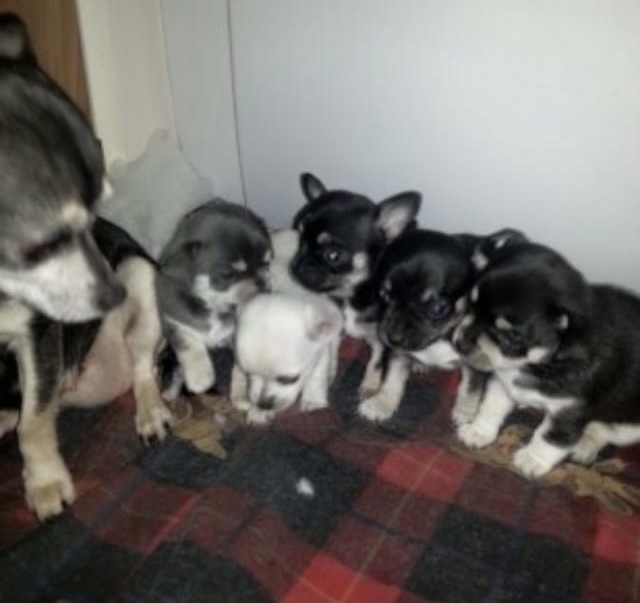
I picked Maddie up and I knew. She was coming home with me.
What I began to understand after that visit was the scale of the crisis in the dog world. Hundreds abandoned every day. Puppy farms churning out badly bred animals for profit. Maddie was the result of bad breeding — we think the mother she was with wasn’t actually hers, and that her real mother likely died giving birth. She would be ill for most of her life.
If I had known that from the start, I don’t think it would have changed anything. I still would have taken her home. This tiny little dot that the woman claimed was over eight weeks but we think was closer to five or six. For the first few weeks of her life, she lived inside my jumper, always warm, always with me.
As her character developed it became clear she was going to be a handful. Cheeky, determined, absolutely certain of herself at all times.
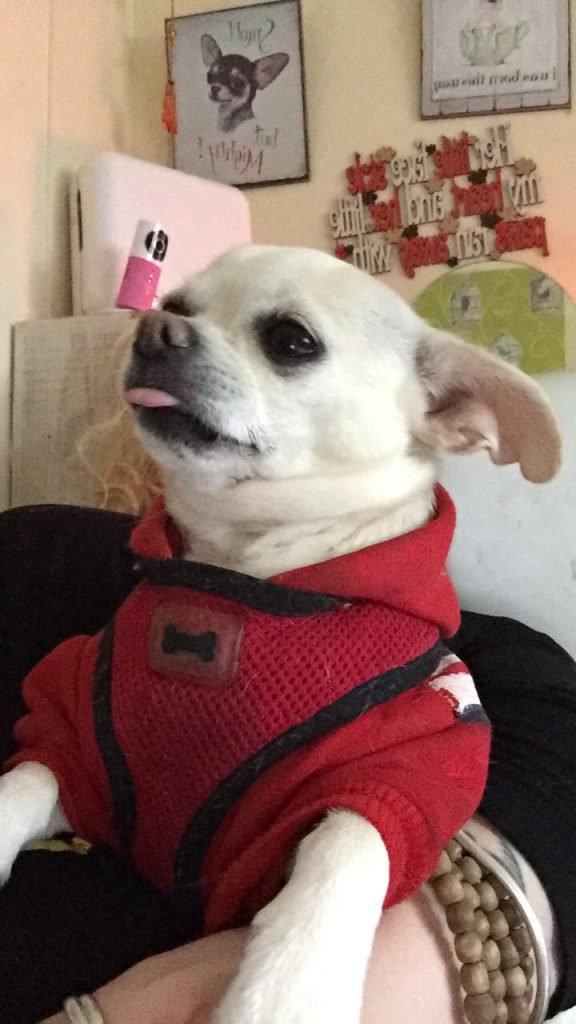
Because of what I had seen at that breeder’s house, I felt compelled to get involved in rescue. Before long our house was a constant stream of foster Chihuahuas coming and going — over a hundred dogs rescued and rehabilitated over the years, with Maddie at the centre of all of it. She knew exactly how to bring a new dog into the pack. She’d warn them who was boss — quietly, firmly, never aggressively. I remember one night a dog was playing up at bedtime and Maddie walked over, calmly pushed it against the wall, and just stared it down. The dog dropped its head and went to bed without another word. She was a born leader.
The moment I knew she was truly something special came when we were heading out one Sunday for dinner. As usual all the dogs were settled in the lounge with treats. As I shut the door behind me, Maddie let out a piercing squeal — the kind that makes your stomach drop, like something terrible had happened. We ran back in. She pushed past us, trotted to the back door, and stood there looking at us as if to say: you are not leaving without me.
Our life together was settled after that. She went everywhere I went. If she couldn’t go, I largely didn’t go either.
She picked up very quickly on the fact that I had good days and bad days. She knew before I did how I was feeling, and she always knew exactly where to position herself. We started experimenting with assistance dog tasking and she was extraordinary. I remember taking her to a college open day — just me, my son, and Maddie — and the heat and the crowd began to overwhelm me. At the time I didn’t yet know that part of what I was dealing with was HyperPOTS. Maddie started circling me, barking, creating space. To anyone watching she probably looked like she was misbehaving. To me it was perfectly clear: she was building a ring around me, keeping people back, giving me room to breathe.
She did it without being asked. She just knew.
In October 2019, I broke both bones in my leg.
The irony is that I was trying to stop Maddie walking off a wall in the garden — only a small wall, but she’d been having trouble with her vision and I was worried. I raced across the garden, slipped on a couple of steps, kicked the kitchen wall, and went down. When I looked up, Maddie was standing calmly on the wall watching me with an expression that said what on earth are you doing, before walking along the wall and down the steps to join me in a heap on the floor.
During my recovery, lockdown hit — and so did something far worse. Maddie became desperately ill. She couldn’t stand or walk. In floods of tears I rang the vet and said I needed them to come to the house because something fatal had happened and I couldn’t put her through a journey.
The vet noticed something that everyone else had missed: a very slight tilt to Maddie’s head. She recognised it immediately as a sign of meningitis.
In dogs it’s autoimmune, and generally once they have it, their life expectancy is short. We rushed her to the emergency animal hospital. They confirmed the diagnosis, kept her in, gave her an MRI which found lesions on her brain, and put her on steroids and — remarkably — chemotherapy. She had chemotherapy periodically for a year.
To everyone’s amazement, she made a full recovery.
She was blind after that. It didn’t stop her. Not for a single moment.
After her recovery, Maddie became something of a legend in the veterinary world — genuinely, quite far beyond our local town. Vets and nurses who had heard about her would ask after her. Nobody could quite believe how much she had survived, or how fully she was living. She suffered a lot in her life. I sat up through many, many nights with her. But you just could not keep her down. She was, in the truest sense of the word, a medical marvel.
In 2024, Maddie was diagnosed with a heart condition — partly from the medication, partly from the poor breeding she was born into. In the end, it was that which took her from me.
On the 19th of August 2024, she died in my arms at the vet.
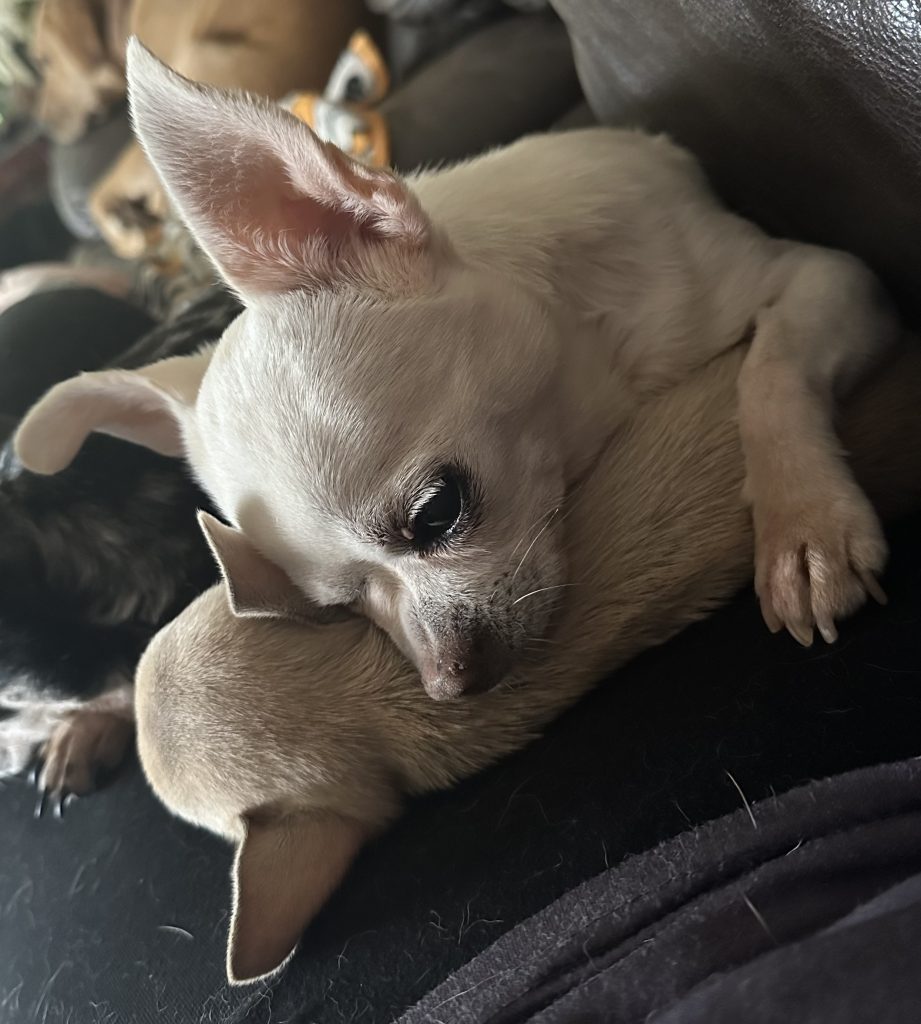
It wasn’t how I had imagined it. Not how I wanted it. But looking back, it was probably the best way it could have been. My daughter was there. Everyone cried. My heart shattered. And as they put the needle into her little leg, a massive hailstorm broke across the tin roof of the vet’s surgery — sending shivers down my spine and tears streaming down every face in the room.
The world mourned with her. The noise as she slipped away was extraordinary. And in that moment I understood that the universe knew exactly how special she was.
Her final act, in true Maddie fashion, was to pee all over me.
Which just about summed her up entirely. Life on her terms, always.
Her popularity was so great that staff came in on their days off to say goodbye to the amazing little white dog who had touched so many lives. The card I received from the vet had one line that has stayed with me ever since:
“I hope you can remember her for the pure magic that she was.”
I was so lucky to have her as my soulmate for eleven years.
The hardest thing I have ever done — and I have done a lot of hard things — was walking out of that vet without her in my arms. Her ashes rest by my bedside, where they will always stay. And her beautiful portrait is tattooed on my arm, where she will always be with me.
Life hasn’t quite been the same since. But I knew she wouldn’t want me to give up.
My health has now been formally diagnosed as EDS, HyperPOTS, MCAS, FND, diabetes, and a few other things I won’t bore you with. My second assistance dog, Mellie the Labrador, came in 2022 — but she was attacked by another dog while working and now struggles in crowds. She still helps me every single evening, quietly and without fuss, but her public access days are behind her.
I don’t foster and rehabilitate as much as I used to, though I will always help if I’m asked. What I’m focused on now is owner-trained assistance dogs — building the next team, documenting the journey, and sharing everything I know.
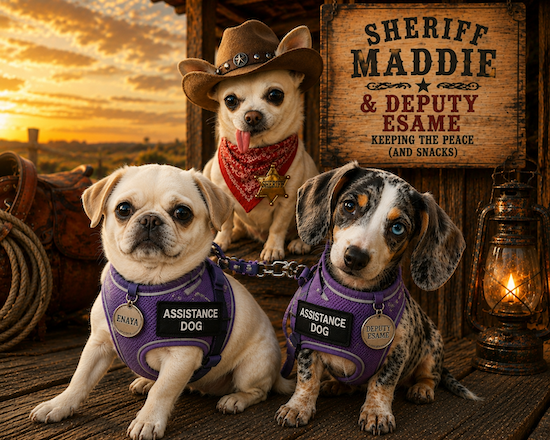
The next generation has arrived. Esmae the dachshund, and Enaya the chi-pug. I wasn’t sure whether either would be suitable for assistance dog work. The more I’ve researched, the more I’ve come to believe that together, they make the perfect team.
And that is where you join us today.
That little white dog who taught me everything — she never stops being everything to me.
My darling girl. My world.
Mad’s Muse — Inspired by Maddie. Made for you.